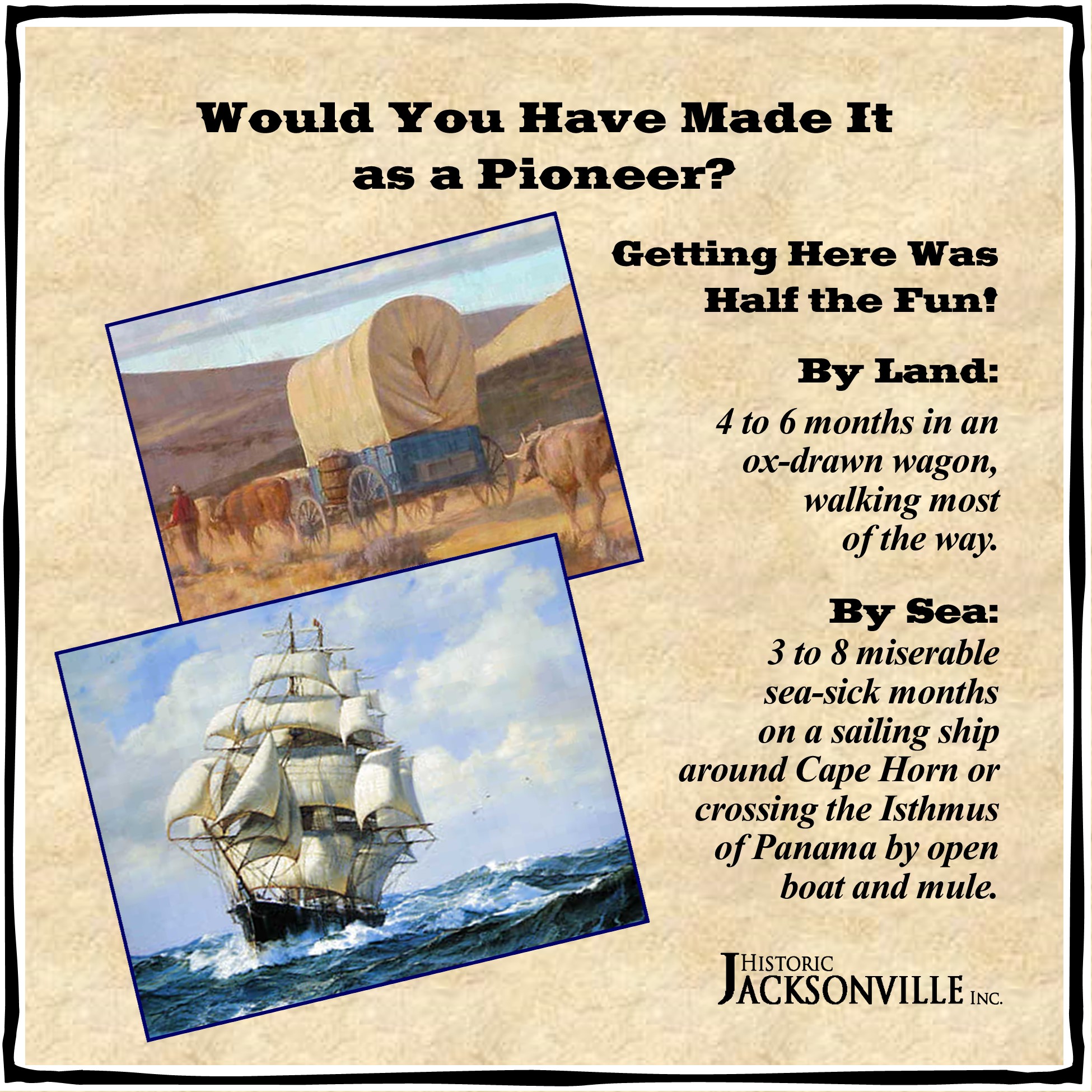
In the early 1850s, Southern Oregon offered the promise of gold and free land. But first you had to get here. There were 2 alternatives—by land and by sea.
By land, you would have traveled up to 6 months in an ox drawn wagon laded with all your remaining worldly possessions, crossing prairies, deserts, and mountains—probably walking much of the way to spare the animals. You would have forded rivers, possibly fought off Indians, run out of supplies, and buried family members along the way. But this overland passage was not viable in winter. The alternatives were a voyage around Cape Horn or a Central American crossing.
By sea, if you chose Cape Horn you would have endured a hazardous trip of 3 to 8 months depending on the wind currents and weather conditions. You would have been jammed in with other passengers, experiencing unsanitary conditions, rough storms, sea sickness, boredom, and a limited diet which often led to scurvy. Or you may have spent three months on a sailing ship (probably in steerage) braving the rocky seas from the East Coast to Panama; crossed the isthmus on foot or by open boat and mule, often in driving rain, while hoping to avoid malaria and yellow fever; then competed for passage to San Francisco. From there it was part boat, part horse or muleback, part “shank’s mare” to the mining fields.
In 1852, if you had made it to the mining camp that became Jacksonville, your home would probably have been a tent; your “kitchen would have been a campfire or cook stove; and your bathroom (assuming you observed the “niceties”) a tree or bush, until you could throw up a shanty and find gold or claim free land.
Would you have made it as a pioneer?