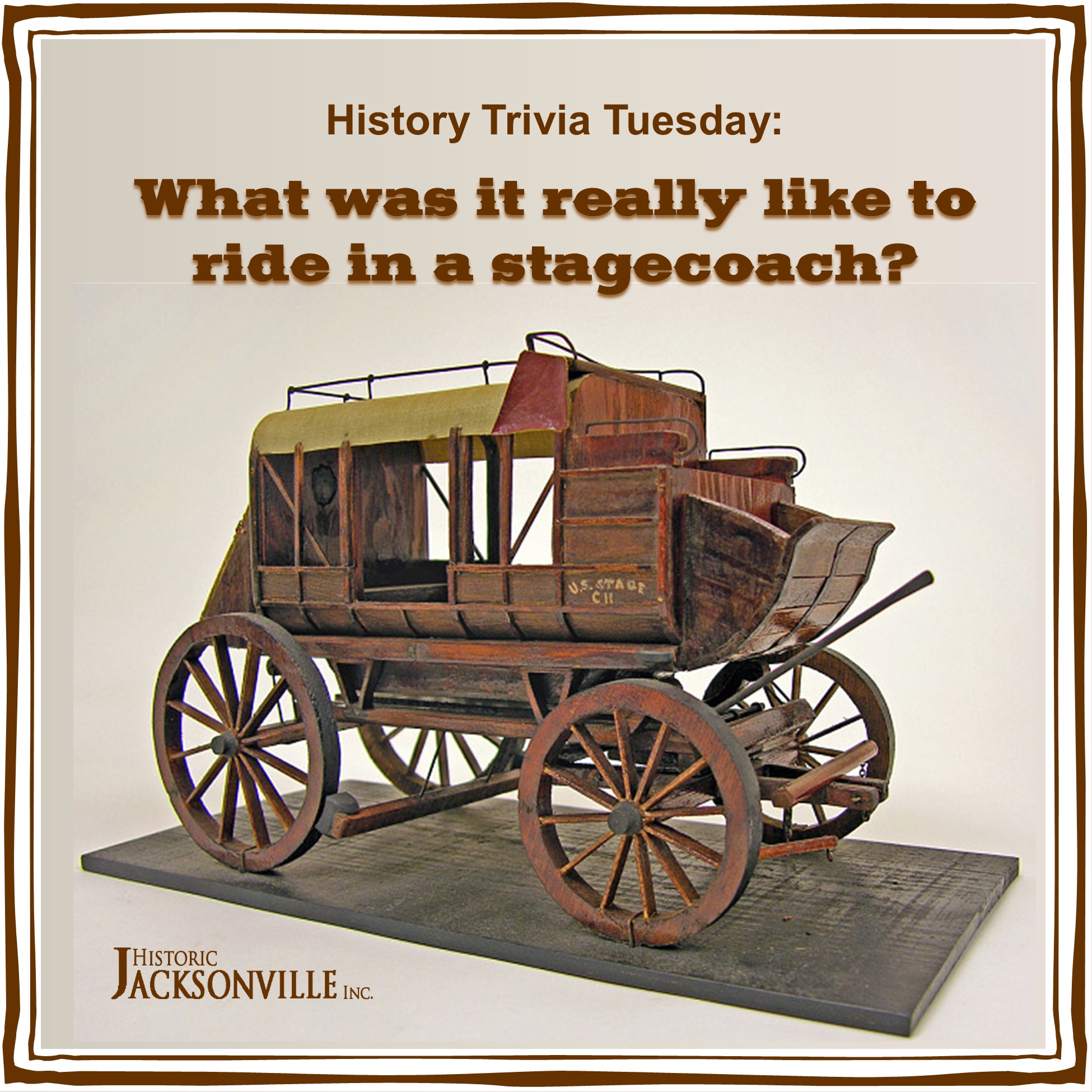
Have you ever wondered what it would be like to ride in a stagecoach? An 1865 traveler between Jacksonville and Yreka wrote about the “luxury” of travel in a stagecoach, or “mud wagon,” as they were called.
Picture a covered wagon. “Inside there are three seats, cushioned with leather cushions, more solid in feeling than the boards beneath, while the floor has several good large cracks, suitable for the free circulation of cold air, and which are highly instrumental in making the feet very uncomfortable. The backs of the seats are strips of cushioned boards, which reach just to that place in one’s back where a little support is ever so agreeable, and yet fails to reach it so universally that the spinal column weakens after a few miles’ riding, and the inclination is to get into a variety of positions, more to be felt than enjoyed. The curtains, devoted to the ‘comfort of passengers,’ have several air holes, or rather ventilation places, through which the wind makes a very sad and deplorable squeak as it squeezes through and pinches the auricular attachments of one’s aching head.
“A ‘stage’ has capacities for carrying freight, mail and passengers, of enormous amplitude. After piling on the small effects of passengers—twelve or fourteen large trunks, six or seven valises and as many blankets, baskets and bundles—the mail is added, sometimes ten or more bags; then express boxes, made of pine wood, but mounted with an iron lock large enough to use on a London penitentiary; then a few boxes ‘going by express.’
“A variety of loading is added, a Mexican saddle and a box of apples; then a ham…then a box of candles, a few pounds of old cheese, a pair of boots, …a small chicken coop and a new shovel for Smith, on the summit; a keg of mackerel, a bottle of old rye, a bag of corn and case of kerosene oil….”
And did we mention that if the wagon gets stuck in the mud, the passengers have to get out and push!