Category Archives: Commercial

Jacksonville Marble Works

Stone mason J.C. Whipp came to Jacksonville from Portland in 1883 to build the foundation for Jackson County’s historic courthouse, including laying its cornerstone. He opened his Jacksonville Marble Works around 1885. They were originally located “just north of town,” but after the 1888 fire destroyed David Linn’s furniture factory, he moved them to the corner of California and Oregon streets. Whipp was described as “doing the best of work,” and having “no peer in this part of the state.” Whipp may be best known for his many marble monuments in Jacksonville’s pioneer cemetery as well as cemeteries throughout southern Oregon and northern California, but he also built culverts and bridges. In 1887, he turned the Methodist Episcopal Church 180 degrees to face the new North 5th Street thoroughfare, and in 1893 he created a stone mantelpiece that won a blue ribbon at the Chicago World’s Fair. Whipp operated his Jacksonville Marble Works until 1902 when he was persuaded to move to Ashland.

Jacksonville Inn Origins

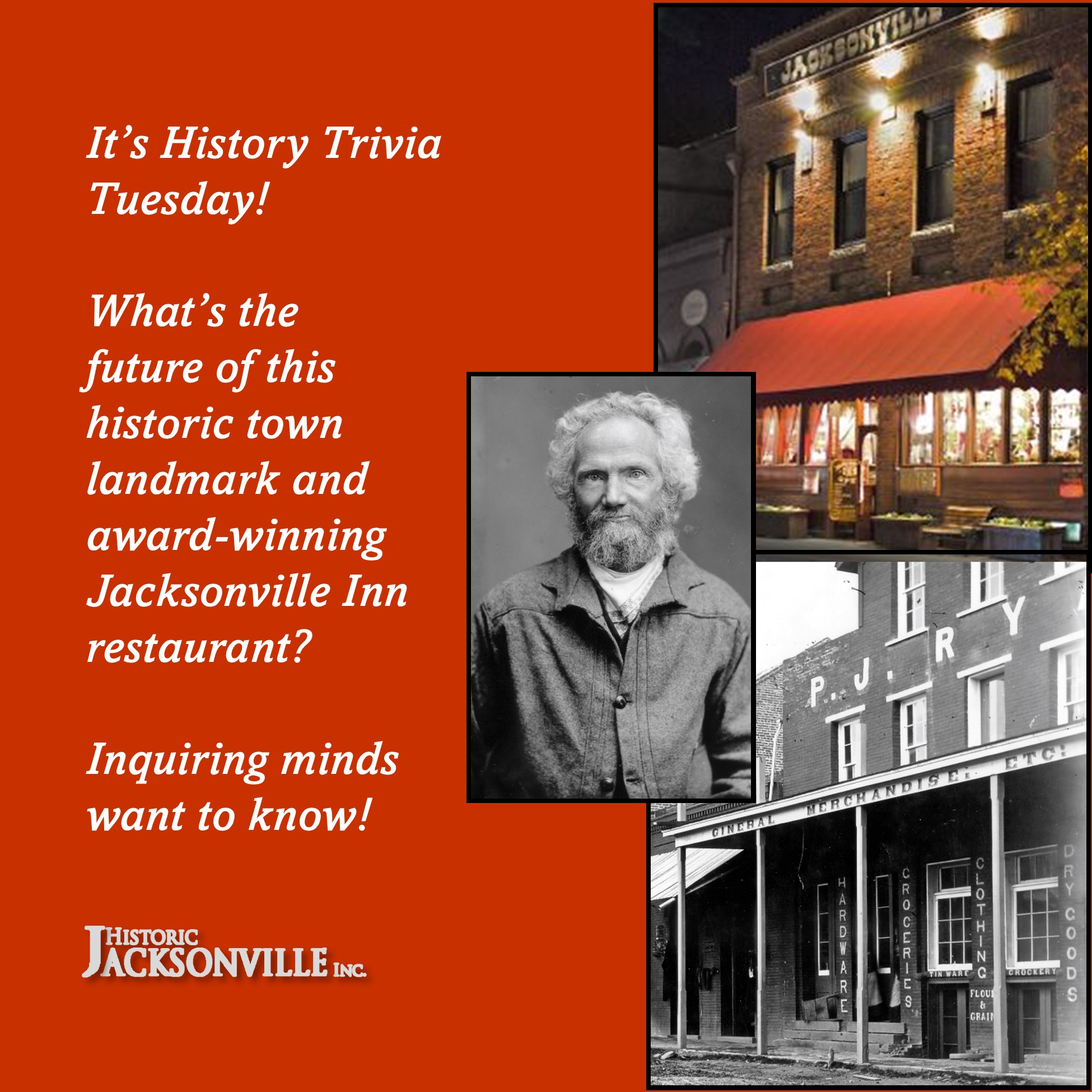
The building we know today as the Jacksonville Inn was originally P.J. Ryan’s storehouse.

The building itself was originally P.J. Ryan’s storehouse. Irish immigrant Patrick Ryan was early Jacksonville’s most prolific builder of “fire-proof” brick commercial buildings. In 1861 he constructed a 1-story brick mercantile store at 175 E. California, variously occupied by Judge’s Saddlery, H. Bloom, and “M. Menzer Gen’l Mdse.” Ryan himself occupied the building when it burned in the April 1873 fire. He suffered one of that fire’s heaviest losses—the building itself plus $30,000 in merchandise.

Within a year, Ryan was erecting a 2-story brick mercantile warehouse on the previous foundation. Months later, the building “continued heavenward” with a 3rd story wooden “pent house,” (later removed), making it the tallest building in Oregon. The Oregon Sentinel proclaimed it to be “as fine a building of the kind as there is in any town this size in the state.”  Ryan’s store was on the ground floor and his living quarters on the second floor.  Who occupied the “penthouse” is unknown.

 Over the next century, the building was occupied by a mercantile, the post office, a flour and feed store, and other entities until, like many of Jacksonville’s commercial structures, it became derelict after the railroad bypassed Jacksonville and the county seat was moved to Medford. 

In the 1960s, Mayor Jack Bates purchased the building as part of Jacksonville’s celebrated revival which created the town’s National Historic Landmark District.  In 1976, Jerry Evans and his wife, Linda, purchased the Jacksonville Inn. Jerry dedicated the next 45 years of his life to keeping the renowned inn and restaurant up and running.  But in 2021, at age 85, he decided to move on to other pursuits.

According to the current owners press release, the restaurant is currently up for lease, but the Inn and wine shop will continue in operation.  Let’s hope that there will be new owners who reopen the restaurant and that the tradition of Jacksonville Inn hospitality continues into the foreseeable future!
Jacksonville Barbershop

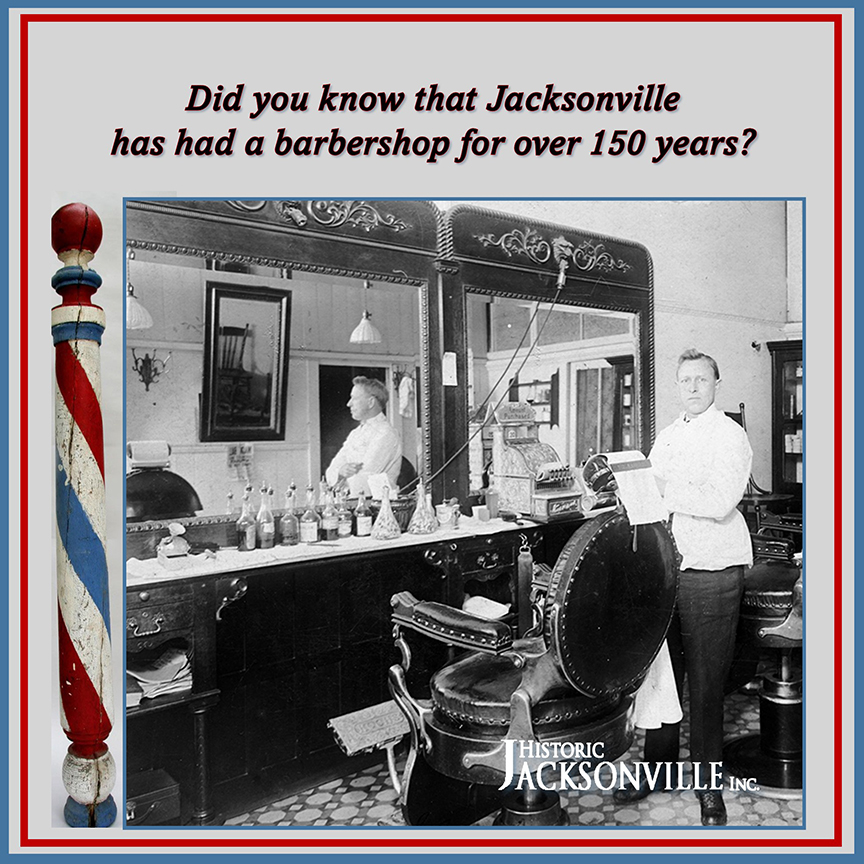
Did you know that Jacksonville has had a barber shop since the 1850s?
The shop itself has moved around a bit for most of the time it has stayed in its current vicinity, moving between 135, 145, 155, and 157 W. California Street and the ground floor of the 1870s Masonic Hall.   

One of the longest serving barbers, and the first town barber “with training,” was George Schumpf.  In 1873 he purchased Blackwell’s barbershop lodged in the notorious El Dorado Saloon.  The saloon stood on the corner of California and Oregon streets from 1852 until the building was destroyed in the town fire of 1874 along with most of the town’s early wooden structures,

Schumpf immediately rebuilt, erecting the brick structure at 157 W. California, and by November of that year he was occupying his new brick establishment.  In addition to shaves and haircuts for men (and women), patrons could also enjoy “neat bathing rooms and bathtubs” where they could obtain “a bath, hot or cold.”  Although Schumpf lost ownership of his shop in in 1882 due to poor business speculations, he remained “the town barber” until his death in 1897. 

We know that a Mr. Murphy was operating the barbershop in 1911 at the current site, and that a William Puhl was subsequently the barber (and subject to a rather messy Halloween trick—see our Holiday History website page). In the 1930s the barbershop occupied a shop facing S. Oregon Street in the Masonic Hall, and in the 1950s, the barbershop briefly occupied a building at the corner of North 4th and California (our current People’s Bank) before returning to its current location.

Happy Alpaca

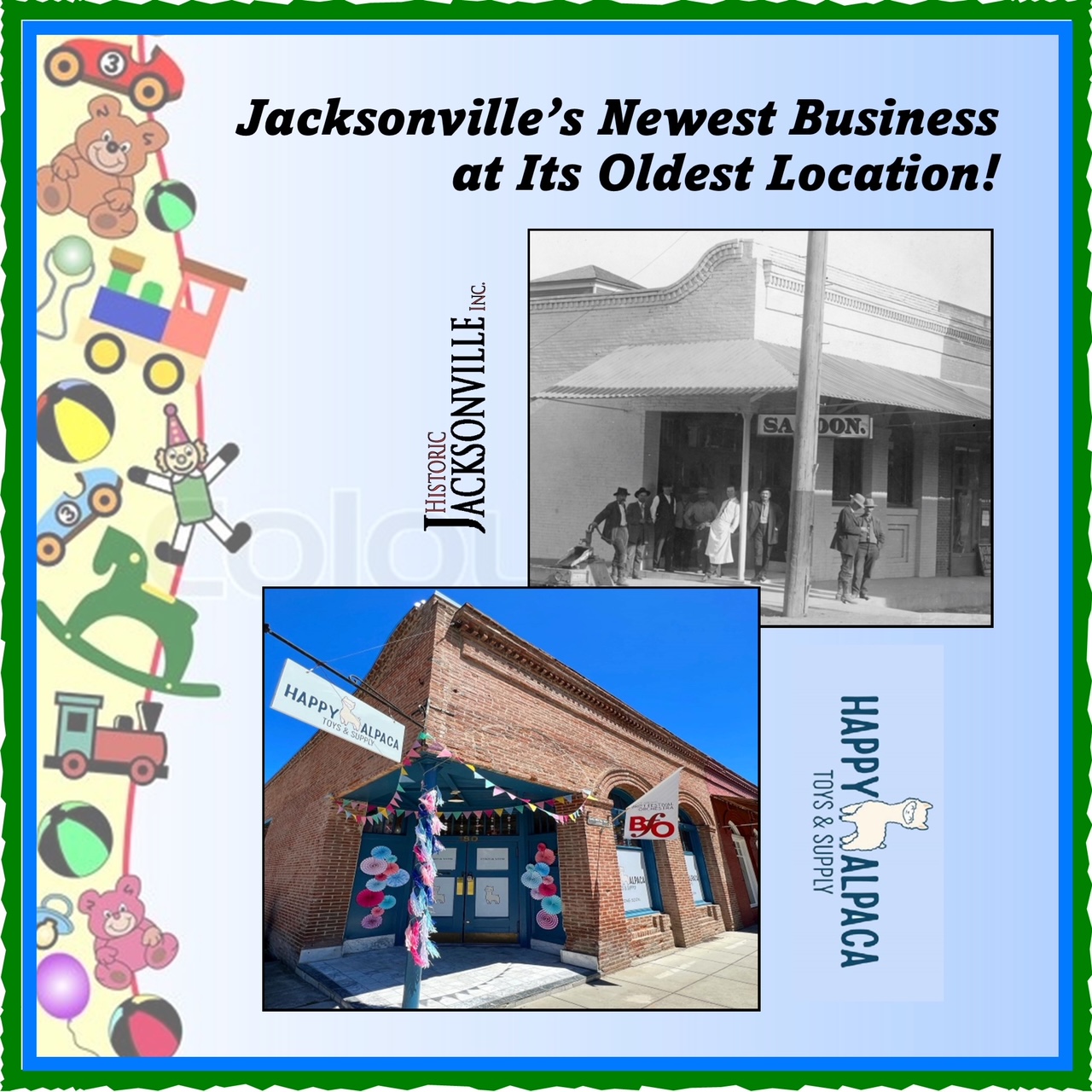
Early in 1852, soon after news of the gold discovery in Jacksonville spread to California, Kenny and Appler, two packers from Yreka, established the first trading post on this site.  They stocked it with a few tools, clothing, boots, “black strap” tobacco, and a liberal supply of whiskey, essential items for an infant gold mining camp.

By 1856, their tent had been replaced by a wooden store and then by a brick storehouse.  In 1860, merchants Abraham and Newman Fisher acquired this prime corner location for their dry goods and general merchandise store.  Fires consumed their stores in both 1868 and 1874.  Despite a $28,000 loss in the latter conflagration, the Fisher brothers rebuilt, and the 1874 A. Fisher & Brothers structure still stands today—although it has been through quite a few changes.

One of its longest tenants was the Marble Corner Saloon also known as the Marble Arch Saloon.  The saloon occupied the building from around 1890 to 1934.  The saloon was presumably named after the Jacksonville Marble Works which in 1888 was located across the street…or because the saloon’s recessed entryway was tiled with marble from its neighbor.

The Scheffel family purchased the building in 1868 and moved into it in 1871.  It was Scheffel’s for the next 50 years, first an antique store then a popular specialty toy store.  We’re delighted that the Kranenburg and Butler families are continuing the tradition of being a children’s toy and specialty story—especially since the Happy Alpaca is now the only one in the Rogue Valley!

George Schumpf Barbershop

In 1874, George Schumpf erected the 1-story arcaded brick building at 157 W. California Street (no doubt simultaneously with its “twin” next door) after a raging fire destroyed most of the block’s original wooden structures in spring of that year. Schumpf, a native of Alsace, Germany, was probably Jacksonville’s most successful and longest established barber. As early as 1868, he may have had a barbershop in this building’s wood frame predecessor, possibly part of the notorious El Dorado Saloon. In fact, according to the Oregon Sentinel, the 1874 fire may have originated over Schumpf’s store in the “Town Club Room.” But by November of that year, Schumpf was occupying his new establishment. In addition to shaves and haircuts for men (and women), patrons could also enjoy “neat bathing rooms and bath tubs” where they could obtain “a bath, hot or cold,” and a boot black stand where they could have their shoes shined in a “most artistic style.”

Farmhouse Treasures Building

Farmhouse Treasures at 120 West California Street is located on one of the few spots in Jacksonville that was used continuously for medical related purposes for almost 140 years. G.W. Greer, “physician and surgeon,” operated an office at this site as early as 1855. By 1862, Dr. L.S. Thompson had joined Greer in dispensing drugs and medicines. In 1868, Sutton and Stearns were carrying “everything usually found in a first class drug store.” Three years later Robert Kahler owned the City Drug Store. Kahler had the current 1-story brick building constructed in 1880, shortly after taking Dr. J.W. Robinson (shown here) into partnership. As late as the 1980s it was an osteopath’s office.

Caro’s Corner

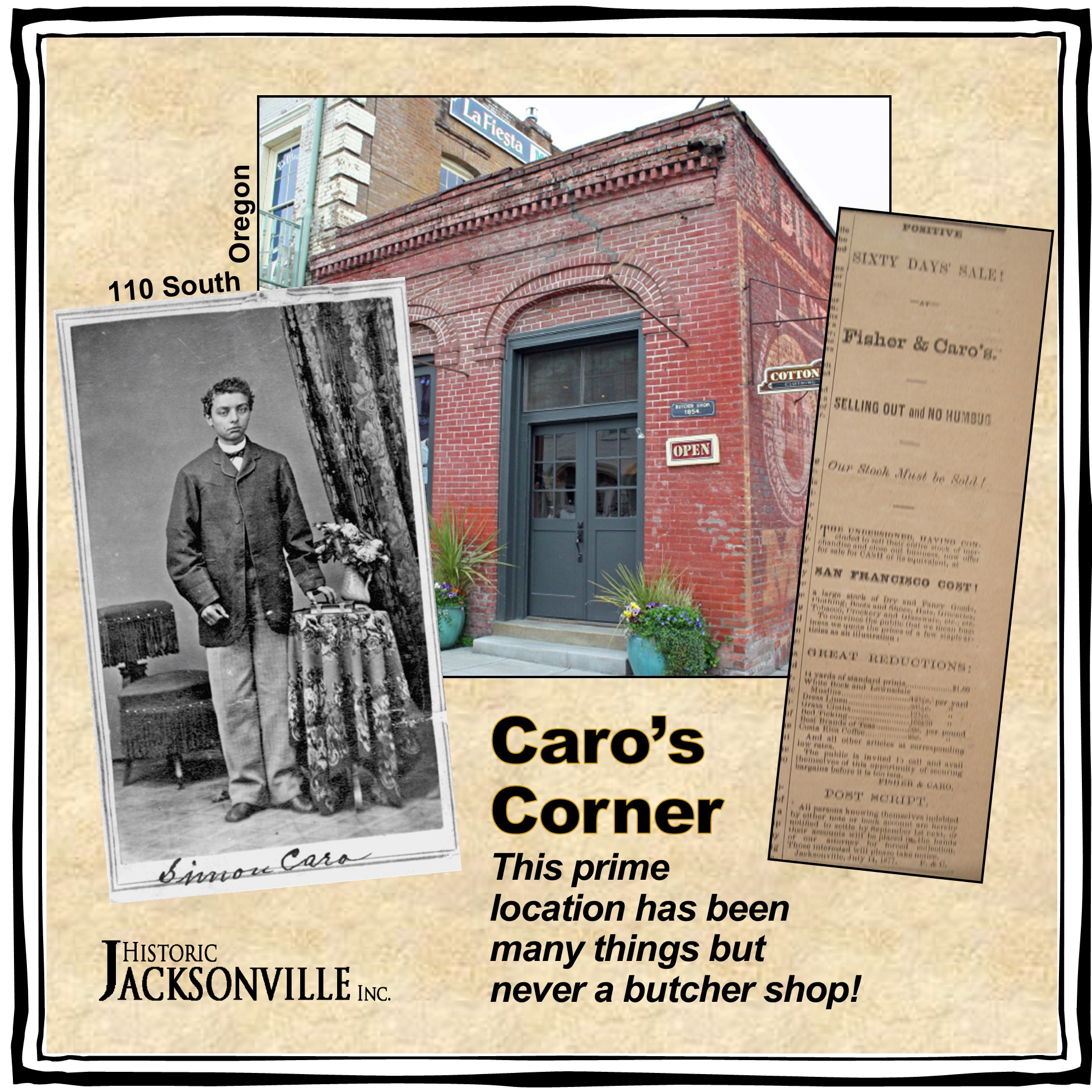
Although this 1-story brick building was constructed in 1861 for the Haines brothers, for many years this prime Oregon and California street intersection was known as Caro’s Corner.  By 1866 Isador Caro was conducting a general merchandise variety store at this site.

That same year, he was joined by his 16-year-old brother, Simon, who arrived in Jacksonville directly from Hamburg, Germany.  While in Jacksonville, Simon learned Chinese to more readily deal with the 800 Chinese miners in Jackson County.  Even when the brothers moved to Ashland in 1870, becoming among the first merchants in that city, the intersection retained its Caro’s Corner moniker.  And Simon did retain local business interests, entering into partnership with the Fisher brothers.

Simon apparently had a real knack for business since the 1870 census showed a 20-year-old Simon as having $500 in real estate and $3,000 in his personal estate and subsequent censuses showed him as head of household.  In fact, Simon was such a success that he was able to visit his mother in Germany every other year until her death.

Blue Door Garden Store

Blue Door Garden Store

The building that is now the Blue Door Garden Store at 130 West California Street in Jacksonville was built around 1862 by German-born John Neuber to house his jewelry store. Neuber was Jacksonville’s first goldsmith and silversmith. He specialized in solid gold buckles for women’s belts. While running to fight one of the periodic fires that broke out in the town’s early wooden structures, Neuber incurred severe head injuries. In 1874 he was declared insane by the Jackson County commissioners and ordered to the state insane asylum where he died a year later.

Bella Union #2

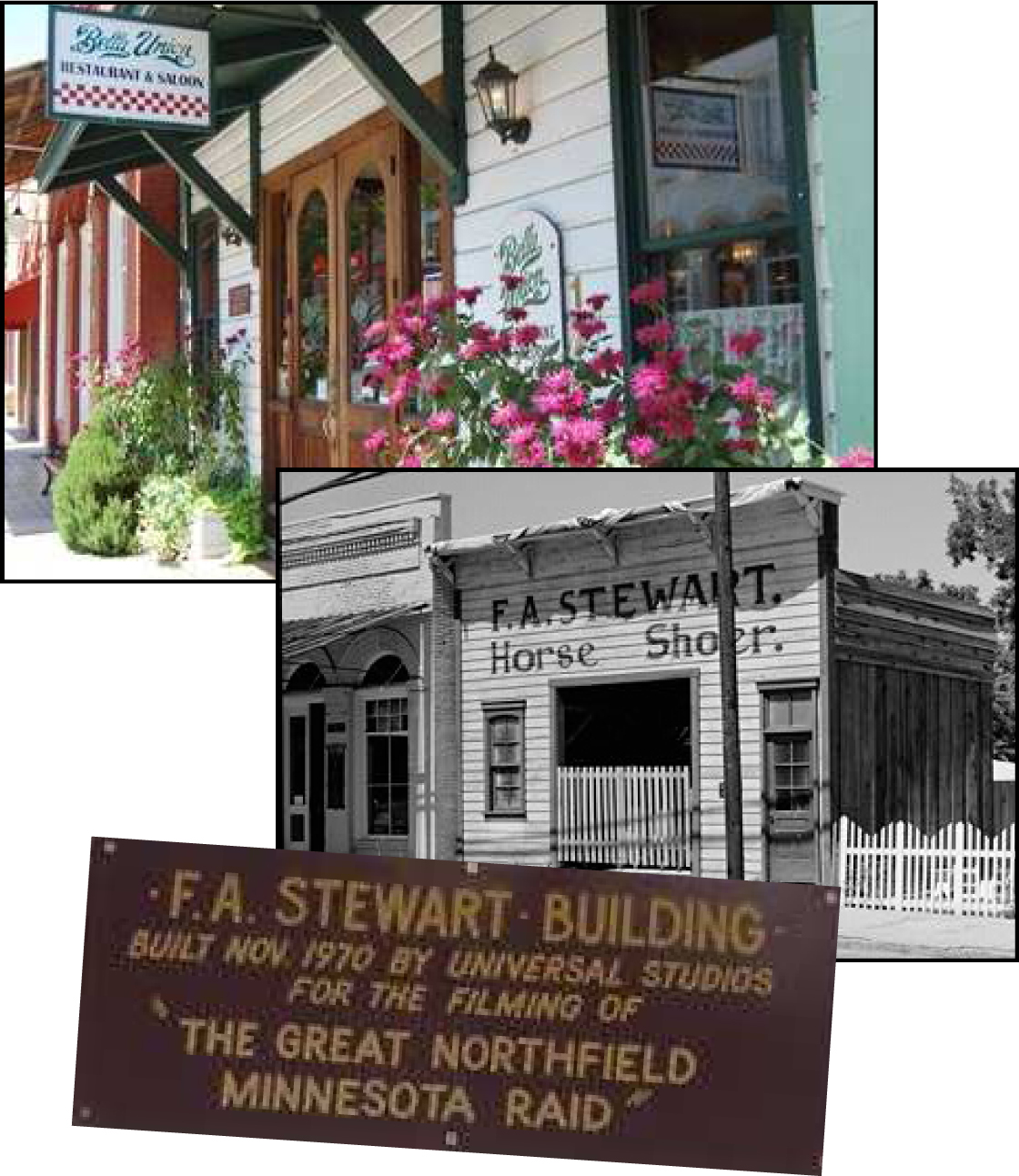
The Bella Union Restaurant and Saloon at 170 W. California Street is not one building, but three. The old brick portion, constructed in 1874, replaced an earlier building that housed the original Bella Union Saloon. The middle portion and main entry is straight out of Hollywood. It was built in 1970 when Jacksonville became the movie set for The Great Northfield Minnesota Raid starring Cliff Robertson as Cole Younger and Robert Duvall as Jesse James. The film is based on the James-Younger Gang’s most infamous escapade—the September 7, 1876, robbery of “the biggest bank west of the Mississippi.”

Bella Union #1

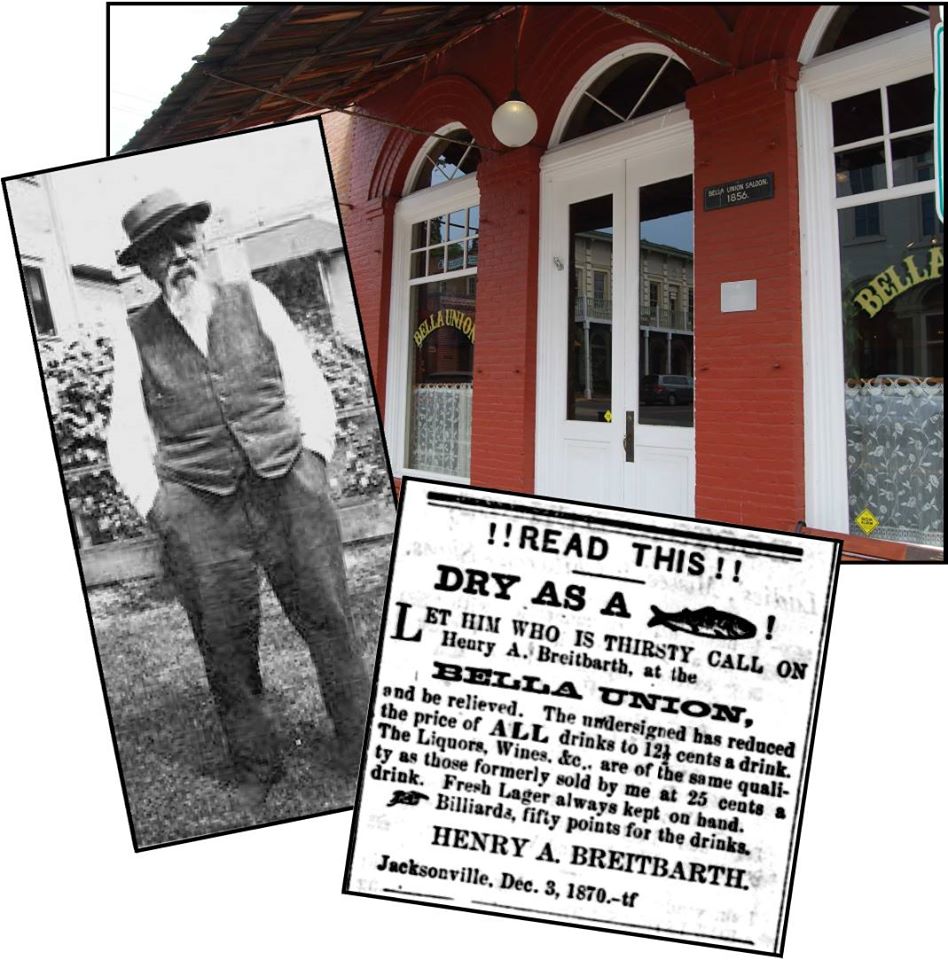
The oldest part of the Bella Union Restaurant and Saloon at 170 W. California Street was constructed in 1874 by pioneer woodworker and builder David Linn after the fire of 1874 destroyed many of the original buildings in Jacksonville. Linn had purchased the lot in 1856 and erected a one-story brick building to house his woodworking shop. After Linn relocated his business to the corner of California and Oregon, he rented the space to a series of tenants, including Prussian native Henry Breitbarth. Breitbarth operated the original Bella Union Saloon at this location from 1864 to 1871. It was one of 7 saloons in early Jacksonville and offered its customers billiards and liquors.

Anderson & Glenn General Store


July 21, 2020
 
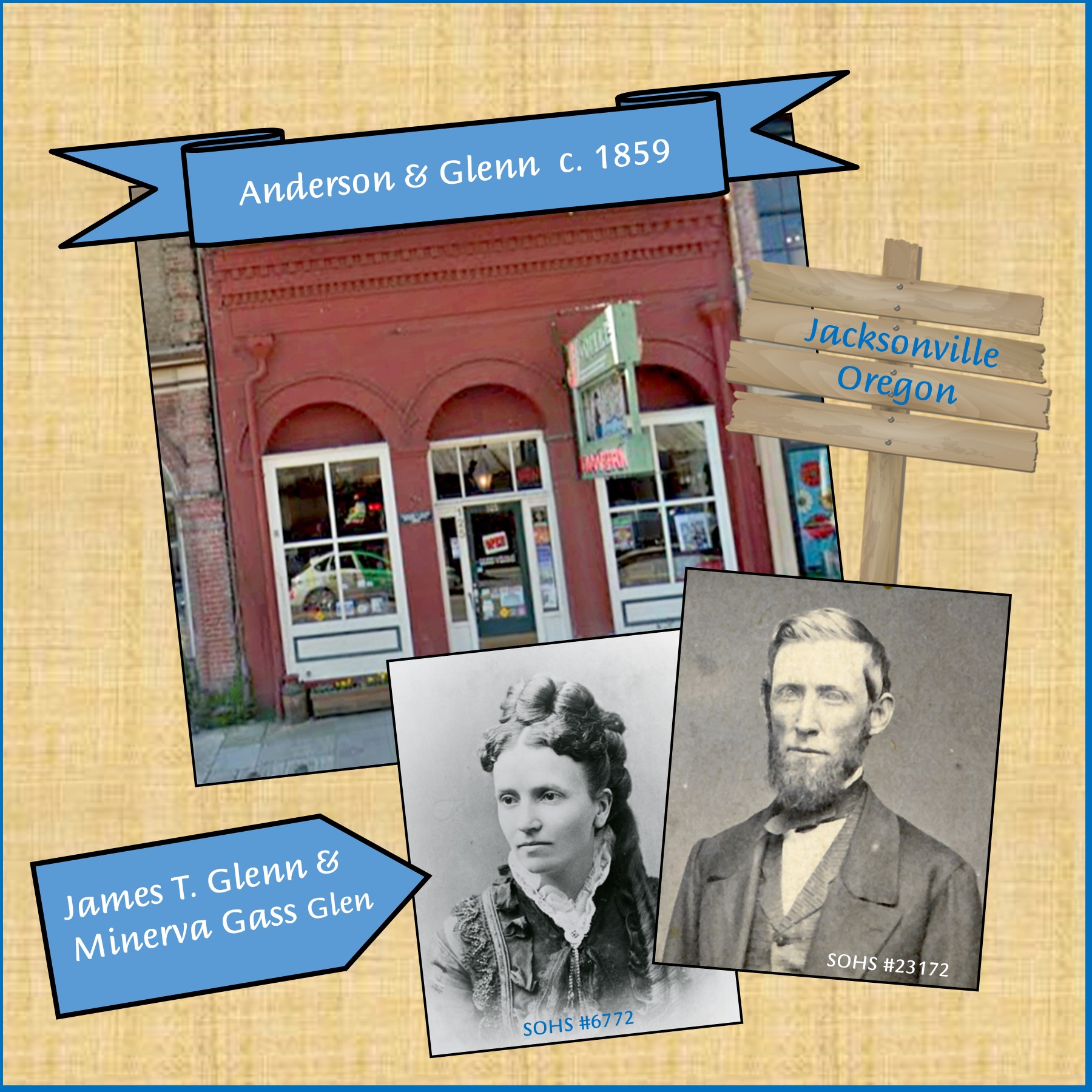
The building at 125 W. California Street in Jacksonville now occupied by the J’ville Tavern was once the Anderson & Glenn General Store. Built in 1859, it was one of the few “fire proof” brick buildings to actually survive the major fires of 1874 and 1884 that took out all the surrounding structures. Anderson was one of Jacksonville’s first merchants. James Glenn joined him in partnership in 1859. Born in Virginia around 1825, Glenn was one of the 49-ers who came west seeking gold. He later turned his hand to farming and became a large landowner with investments in quartz mining and a flour mill. In 1859, he was Treasurer of Jacksonville when it was first incorporated and the town’s 3rd wealthiest citizen. In 1862, Glenn married Minerva Gass, 20 years his junior. Glenn apparently continued in the general merchandise business until the mid-1870s. By 1875, he had moved to Alameda, California where he was a “real estate investor.” The Anderson & Glenn brick store continued to be used as a general merchandise store into at least the early 1900s.

Abstract Company Concrete Building

The Laundry & Quarters, an enchanting Jacksonville cottage, has been an ice cream shop, a doll museum, a perfumery, and an antique store among other uses. 

However, this building at 215 North 5th Street was constructed around 1915 for the Rogue River Valley Abstract Company, what we would today call a real estate title business. It is believed to have been the first reinforced concrete building constructed in Jacksonville, Oregon. 

The building immediately to the north, now the Magnolia Hotel, was built around the same time for the Rogue River Sanitarium. When the County seat was moved to Medford in 1927, the Abstract Company appears to have moved as well and the building was converted into the Sanitarium’s laundry. It apparently remained so for quite a few years since the laundry plumbing still existed well into the 1970s. In fact, the building’s current owner reports that when they wash the floors they don’t have to use soap because the floors create their own suds!